
Reviewed · SUNRISE & MEDITATION TOURS
Chiang Mai Temples Visit Walking Tour with Ex-Monk Guide Part 1
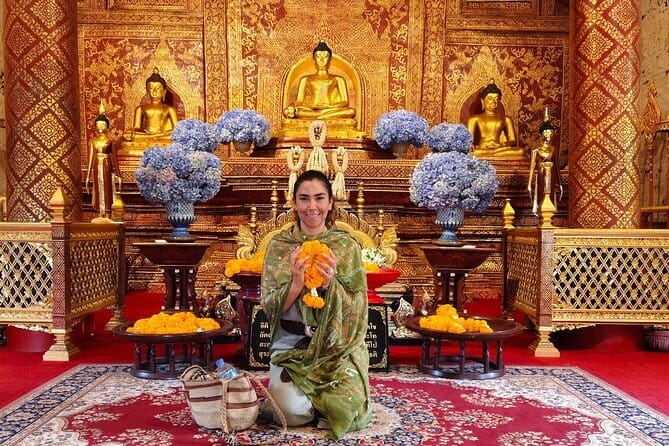
Temples can feel like scenery. This one feels like a lesson. With a former monk guide, I love how Chiang Mai’s main landmarks turn into clear stories about Buddhist ideas, not just pretty buildings—plus the route is close-by sites you can comfortably walk through at an easy pace. The other thing I really liked is the former monk guide perspective, where architecture, symbols, and everyday temple life get explained in plain English or Chinese.
One consideration: temple entrance fees are not included, and that matters most at Wat Phra Singh and Wat Chedi Luang Varavihara. If you’re on a tight budget, it helps to set aside a little extra cash before you go.
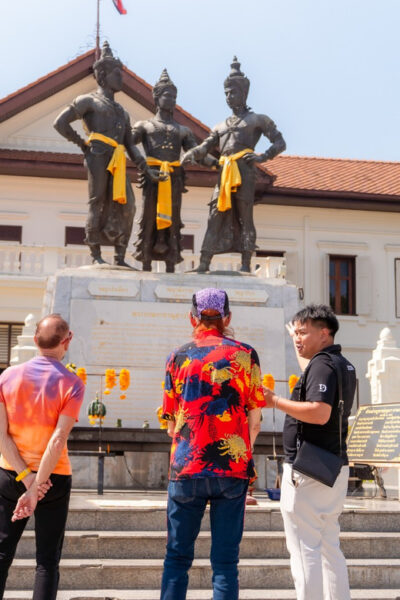
This 3 hours 30 minutes morning walk starts at Three Kings Monument at 9:00 am and loops back to the same spot. It’s capped at 20 travelers, so you get a real conversation with your guide, not just a headset tour.
In This Review
- Key things to notice before you go
- Entering The Three Kings Meeting Point
- What The Walk Feels Like (3.5 Hours, Easy Pace)
- Stop 1: Wat Sadeu Muang And The City’s Pillar Story
- Stop 2: Wat Phra Singh And Why The 14th Century Matters
- Stop 3: Wat Phan Tao And The Teakwood Ordination Hall
- Stop 4: Wat Chedi Luang Varavihara And Chiang Mai’s Largest Stupa
- What Makes The Ex-Monk Guide A Big Deal
- Price And Value: $25.96 For A Licensed Temple Walk
- Timing, Weather, And The Best Day To Go
- Who This Tour Is For (And Who Might Want Something Else)
- Should You Book This Chiang Mai Temple Walk?
- FAQ
- How long is the Chiang Mai Temples Visit Walking Tour?
- Where does the tour start?
- What time does the tour begin?
- Is this tour walking or by vehicle?
- What languages are the guides?
- Are temple entrance fees included?
- How many people are in a group?
- Do I get a ticket digitally?
- What kind of guide qualification is included?
- What happens if weather is poor?
Key things to notice before you go
- Former monk guidance: You’re getting temple explanations from someone who has lived the routine, not just studied it on paper.
- A walkable old-city loop: Major sights are close enough that the walk stays light.
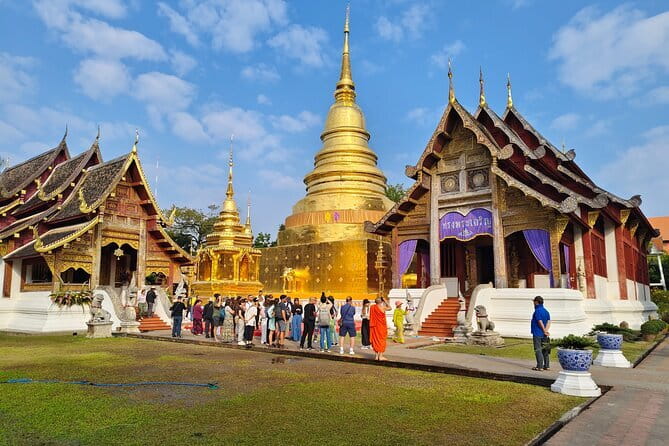
- Buddhism explained through symbols: You learn what you’re looking at—lion statues, sanctuary mosaics, ordination halls, and stupas.
- Some entrances cost extra: Wat Phra Singh and Wat Chedi Luang Varavihara may require tickets you pay on the day.
- Small group feel: Up to 20 people makes it easier to ask questions.
Dawn at the temple: sunrise and monk-blessing visits
- Chiang Mai: Doi Suthep, Wat Umong, and Pha Lat Sunrise Tour
★ 4.7 · 1,425 reviews - Wat Phra That Doi Suthep spiritual Sunrise Tour with an Ex-monk
★ 5.0 · 798 reviews - Spiritual Sunrise Wat Doi Suthep, Pha Lat, Alms & Meditation
★ 4.9 · 674 reviews - Doi Suthep and Wat Pha Lat Sunrise Tour (Small Group Only)
★ 5.0 · 70 reviews
Entering The Three Kings Meeting Point
You’ll meet at the Three Kings Monument area, on Prapokklao Road. Expect a quick intro before you start walking—think orientation, what you’ll see, and the kind of context that helps the next stops make sense fast. It’s also a practical meeting point in Chiang Mai: it’s in a central spot and not far from public transport.
One small thing I appreciate about this start: it gives you time to shift from tourist mode into temple mode. When you begin with a framework—what Buddhism is trying to express, and how Thai temples are built to communicate that—it changes how you read every wall and doorway you pass.
What The Walk Feels Like (3.5 Hours, Easy Pace)
This tour is designed as a morning temple walk, not a sprint. Reviews consistently point out that distances feel manageable and walking is light because the sites are grouped in the old city. At roughly 3 hours 30 minutes, you’re not stuck wandering all day, either—good if it’s your first trip out and you want something meaningful without burning your whole day.
Also, since the guide is English or Chinese speaking and you’re in a small group (max 20), it’s easier to follow along. You’re not just listening—you can ask what a term means, why a detail matters, or what to pay attention to at each temple.
Practical tip: wear shoes you can walk in comfortably for a few hours, even if it’s not a long distance. Temple grounds can be uneven, and you’ll likely move in and out of different areas.
Stop 1: Wat Sadeu Muang And The City’s Pillar Story
Wat Sadeu Muang is where the tour shifts from “learning about temples” to “learning why temples exist here.” You’ll visit an Inthakhin temple connection tied to the city pillar—the idea that Chiang Mai’s heart was anchored by that pillar first placed at this location.
This is one of those stops that can be easy to overlook if you only care about big-name temples. But it’s valuable because it explains the local logic behind spiritual space: sacred meaning isn’t only about distant gods or ancient history. It’s also about how people organized their city, identity, and community.
Plan for about 30 minutes here. It’s a good tempo match—enough time to look closely and absorb the explanation, without dragging the tour schedule.
Nothing jumping out yet? More Chiang Mai trips are just down the page

Stop 2: Wat Phra Singh And Why The 14th Century Matters
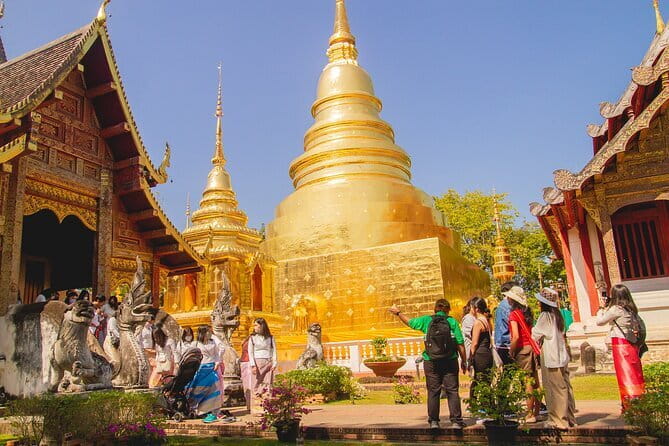
Wat Phra Singh is a major highlight for anyone who wants Chiang Mai temples at their finest. This stop focuses on a temple built in the 14th century, and it’s known for standout details like a mosaic-inlaid sanctuary, a large lion Buddha statue, and gilded pagoda elements (you’ll see a lot of crafted surface work up close).
Here’s why this matters for you: Thai and Lanna Buddhist art often works like visual language. Without context, you might treat it as decoration. With the guide’s explanations, you start seeing patterns—how religious ideas get expressed through form, placement, and iconography.
Expect about 45 minutes at Wat Phra Singh, and this is also one of the places where the entrance ticket is not included. If you arrive ready for that, you won’t feel stalled or stuck budgeting mid-tour.
Practical tip: bring a small amount of cash or be ready to handle any ticket purchase directly. And dress modestly—cover shoulders and knees—to avoid awkward moments at the doorway.
Stop 3: Wat Phan Tao And The Teakwood Ordination Hall
Wat Phan Tao is where craftsmanship becomes the main story. The big attraction here is its Lanna-style ordination hall (also called a wihan), built entirely from teakwood. The tour also notes that this hall served as a throne hall during the reign of King Mahotara Prateth—so it’s not only a religious space, but also a window into how power and Buddhism shared the same world.
This stop is one of the best examples on the route of how Thai temple architecture blends multiple purposes. You’ll be looking at woodwork and structure, but the guide helps you connect that physical design to function: ceremonies, leadership, and community life.
Time on site is about 30 minutes, and this one lists free admission, which helps keep your costs controlled.
Stop 4: Wat Chedi Luang Varavihara And Chiang Mai’s Largest Stupa
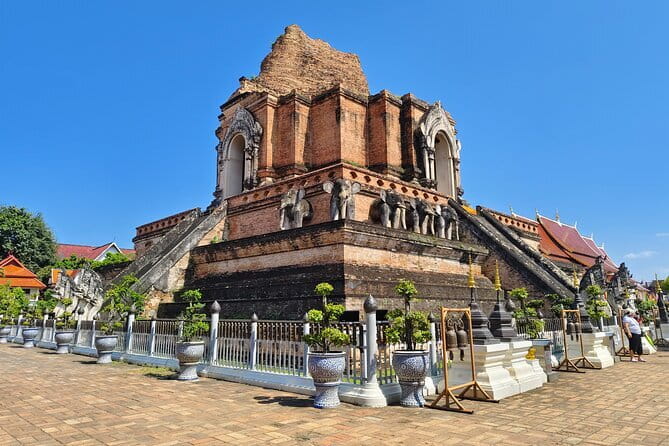
Wat Chedi Luang Varavihara is the payoff temple. The compound is known for having the largest stupa in Chiang Mai, and the walking tour gives you time to explore the sprawling grounds while you spot striking Lanna-style design details close up.
The stupa itself is more than a monument. It’s a statement about memory and merit—built to hold meaning through generations. When you understand that, you don’t just photograph it. You start noticing how the space is laid out for movement, viewing, and reflection.
Expect about 45 minutes here. Like Wat Phra Singh, entrance fees are not included, so factor that into your planning.
Practical tip: take a minute to slow down on the grounds. With a guide you’ll get explanations, but your best learning often happens when you step back and look at the whole layout—what’s central, what’s surrounding, and where people naturally pause.
What Makes The Ex-Monk Guide A Big Deal
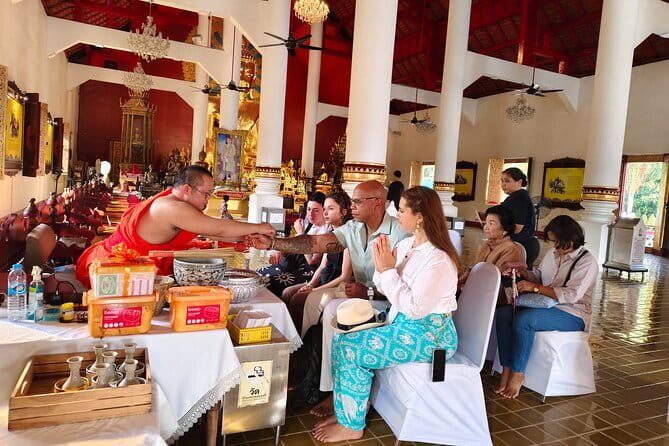
This is the core reason this tour earns consistently high scores. The guide isn’t just reciting facts. The tone is different—more personal, more grounded, and more focused on how Buddhism is lived and understood.
In the feedback I saw, guides like Katoon and Cartoon (names appear in a few spellings) are praised for:
- strong English (so you can actually follow)
- clear, organized explanations
- a perspective that feels lived-in, not academic
If you’re the kind of person who wants to understand what you’re seeing—why a lion statue shows up, why a teak ordination hall is important, what a stupa symbolizes—this kind of guide makes the walk feel worth repeating.
How to get the most out of it: ask one question early. Something like what a symbol means, or how Buddhist teachings show up in temple design. Then your next stops become easier to interpret.
Price And Value: $25.96 For A Licensed Temple Walk
At $25.96 per person for about 3.5 hours, the price is competitive for a guided old-city experience. Here’s the value logic I’d use if I were booking:
- You’re paying for a licensed guide (English or Chinese speaking, holding a TAT license).
- You get explanations at multiple major temple stops, not just one big site.
- You’re keeping walking distances practical in a small group (max 20).
The main cost twist is entrance fees. The tour notes that entrance fees aren’t included, and that affects at least Wat Phra Singh and Wat Chedi Luang Varavihara. If you plan for that extra spend, the base ticket feels like a solid deal.
If you’re traveling with limited time in Chiang Mai, this is also smart value. You get structure on day one: meet, walk a loop, learn the basics, and come away with a clearer sense of Chiang Mai’s religious landscape.
Timing, Weather, And The Best Day To Go
This tour starts at 9:00 am. I like early starts for temple walks because the light is good and the heat feels easier to manage. It also gives you the rest of the day free for markets, food, or another easy sightseeing stop.
The experience is marked as requiring good weather. In real life, that usually means rain can change the plan. If that happens, expect the tour operator to offer a different date or a refund, rather than forcing it in bad conditions.
So if you’re deciding what day to book, pick a morning with the best weather forecast you can find.
Who This Tour Is For (And Who Might Want Something Else)
I’d recommend this walking tour if you want more than photos. It’s a good fit for:
- first-time visitors who want the fundamentals of Buddhism and Thai temple culture
- people who enjoy architecture and want the meaning behind shapes and ornaments
- anyone who values a human guide over a script
It may not be perfect if:
- you strongly dislike paying extra on-site for temple tickets
- you want a purely self-guided experience with zero talk and no discussion
- you’re looking for a long, strenuous hike (this is a light walk, not a trek)
Should You Book This Chiang Mai Temple Walk?
If you want a calm, structured way to understand Chiang Mai’s temple culture, I think booking makes sense. The best part is the ex-monk viewpoint, which turns these places into lessons you can carry into the rest of your trip. Add the small group size and the walkable old-city loop, and you get a tour that feels both practical and genuinely meaningful.
Book it if you’re curious. Skip it if you only want to check boxes and you don’t care why any of the symbols exist.
FAQ
How long is the Chiang Mai Temples Visit Walking Tour?
It runs for about 3 hours 30 minutes.
Where does the tour start?
The meeting point is at Three Kings Monument (QXRP+3WX, Prapokklao Road, Tambon Si Phum, Amphoe Mueang Chiang Mai).
What time does the tour begin?
The start time is 9:00 am.
Is this tour walking or by vehicle?
It is a walking tour.
What languages are the guides?
The guide is English or Chinese-speaking.
Are temple entrance fees included?
No. Entrance fees are not included. Some stops list free admission, while others may require tickets.
How many people are in a group?
The tour has a maximum of 20 travelers.
Do I get a ticket digitally?
Yes, it uses a mobile ticket.
What kind of guide qualification is included?
The guide holds a TAT license.
What happens if weather is poor?
The experience requires good weather. If canceled due to poor weather, you’ll be offered a different date or a full refund.
More Tours in Chiang Mai
- Chiang Mai: Doi Inthanon National Park Eco-Friendly Tour★ 4.6 · 6,667 reviews
- Chiang Mai: Elephant Sanctuary & Waterfall Group Tour★ 4.9 · 5,780 reviews
- Chiang Mai: Cooking Class, Market & Thai Herbs Garden Tour★ 4.9 · 4,824 reviews
- Chiang Mai: Elephant Sanctuary Feeding Program Half-Day Tour★ 4.8 · 4,527 reviews
- Chiang Rai White Temple and Blue Temple Day Tour★ 4.6 · 3,366 reviews
More Tour Reviews in Chiang Mai
- Half-Day Thai Cooking Class at Organic Farm in Chiang Mai★ 5.0 · 19,087 reviews
- Chiang Mai: Elephant Sanctuary, Waterfall & Bamboo Rafting★ 4.9 · 9,160 reviews
- Chiang Mai: Doi Inthanon National Park Eco-Friendly Tour★ 4.6 · 6,667 reviews
- Chiang Mai: Elephant Sanctuary & Waterfall Group Tour★ 4.9 · 5,780 reviews
- Chiang Mai: Chiang Rai Temples, Karen Tribe and Hot Springs★ 4.7 · 5,401 reviews
More Sunrise and Meditation Mornings
- Chiang Mai: Doi Suthep, Wat Umong, and Pha Lat Sunrise Tour★ 4.7 · 1,425 reviews
- Wat Phra That Doi Suthep spiritual Sunrise Tour with an Ex-monk★ 5.0 · 798 reviews
- Spiritual Sunrise Wat Doi Suthep, Pha Lat, Alms & Meditation★ 4.9 · 674 reviews
- Doi Suthep and Wat Pha Lat Sunrise Tour (Small Group Only)★ 5.0 · 70 reviews
- Mount Doi Inthanon National Park Sunrise and Hiking★ 5.0 · 52 reviews
Fresh off the pile: Chiang Mai tours we have just written up

Sunrise & Meditation Tours, compared.
 ★ 4.7Doi Suthep, Wat Umong, and Pha Lat Sunrise TourFrom $321,425 reviews
 ★ 5.0Wat Phra That Doi Suthep spiritual Sunrise Tour with an Ex-monkFrom $64798 reviews
 ★ 4.9Spiritual Sunrise Wat Doi Suthep, Pha Lat, Alms & MeditationFrom $59674 reviews
 ★ 5.0Doi Suthep and Wat Pha Lat Sunrise Tour (Small Group Only)From $2970 reviews
 ★ 5.0Mount Doi Inthanon National Park Sunrise and HikingFrom $12652 reviews
 ★ 5.0Meditation Retreat and Self-Care in NatureFrom $4846 reviews
 ★ 5.0Half-Day Yoga, Meditation, and Thai Cultural Immersion in Chiang MaiFrom $7140 reviews
 ★ 4.9Full-Day Yoga & Meditation Experience with LunchFrom $8338 reviews
Browse the lists this tour appears in